Patient guide · Retainers

Retainer care

Why your teeth need a retainer, how long to wear it, and how to put it in, take it out, and keep it clean.

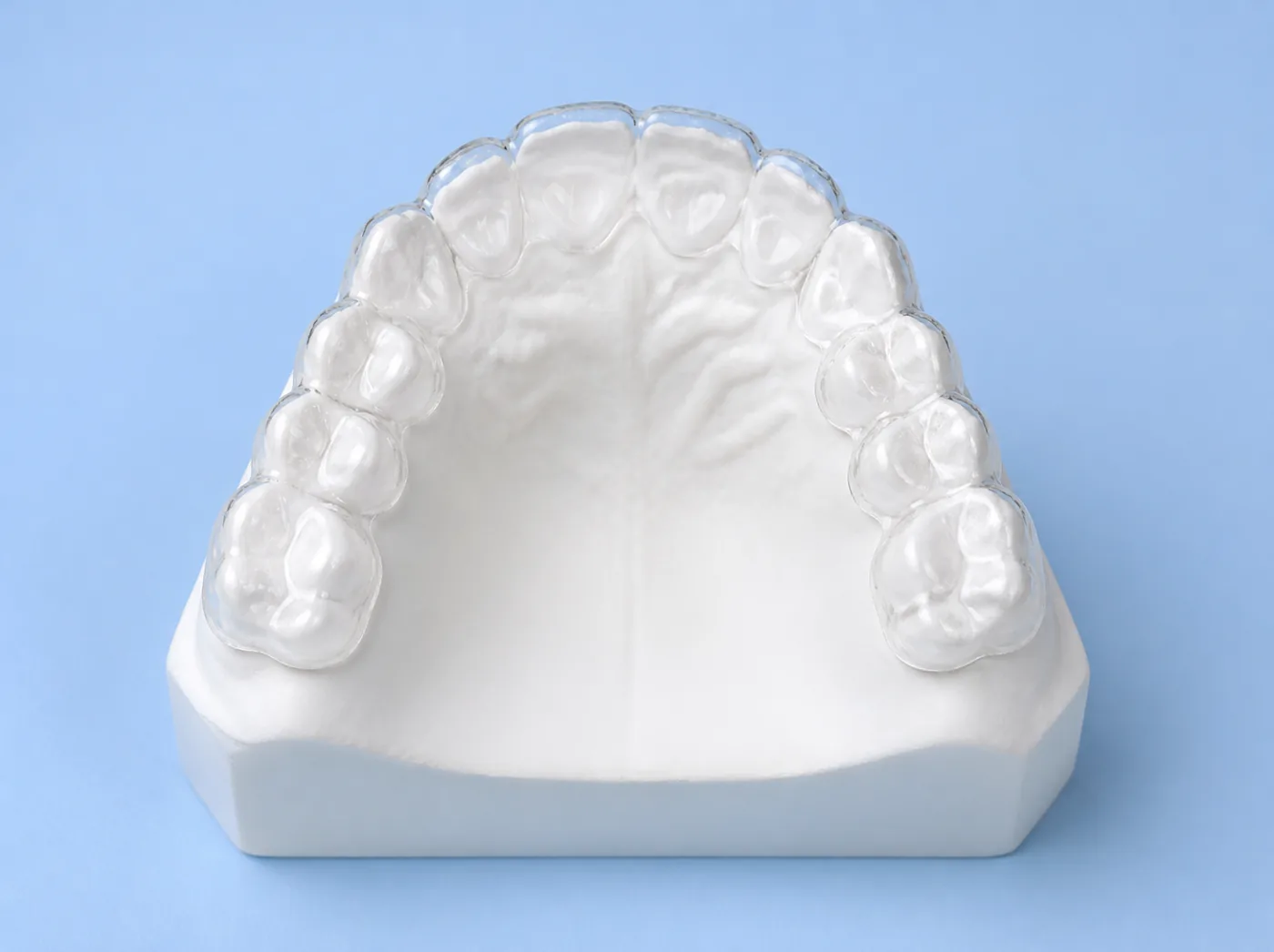
Clear Essix retainer on a model of the upper teeth

Why you wear a retainer

Finishing braces or aligners doesn't mean your teeth are set. Here's what's happening in the bone, and why it decides how long you wear your retainer.

Each tooth sits in a socket of jawbone, held by the periodontal ligament, a thin cushion of fibers between the root and the bone. Bone is living tissue that's always being rebuilt. Braces and aligners apply a gentle, steady push, and three kinds of bone cells do the rest.

The arrow shows the push. The tooth moves right: bone clears ahead of it and fills in behind it.
  1. Osteoclasts, the bone removers

    On the side the tooth is pushed toward, the ligament is squeezed. Osteoclasts gather there and dissolve a thin layer of bone, making room for the tooth to move.

  2. Osteoblasts, the bone builders

    On the opposite side, the ligament is stretched. Osteoblasts lay down new bone to fill in the space the tooth left behind.

  3. Osteocytes, the sensors

    Living inside the bone, osteocytes feel the pressure and send the signals that tell the other two cells where to work.

Why it takes months to settle

When treatment ends, the new bone is still soft and filling in, like fresh concrete that hasn't fully cured. The ligament around each root needs a few months to reorganize. The gum fibers take longer, often a year or more, and they still pull toward the old positions. That's why full-time wear comes first.

Why it's for life

Even after everything settles, teeth keep shifting slowly for life, from chewing, tongue and lip pressure, and normal aging. Lower front crowding in adulthood is common even in people who never had braces. A retainer at night is a small habit that protects your result.

The short version: for about the first 6 months, I wear my retainer all day because my bone is remodeling. After that, I wear it at night for life because I don't want my teeth to shift.

How long to wear it

Your retainer is made from a scan of your finished teeth. Follow the schedule your doctor gives you; this is our usual plan, not a fixed rule.

Daily
About the first 6 months
Then
At night, for life
Replace
About once a year
Made from
Your final scan

Some patients stay on a step 2 to 3 months longer. Research hasn't settled on one best schedule; studies have used about 6 months of full-time wear before switching to part-time (Martin et al., Cochrane Database of Systematic Reviews, 2023).

  1. About the first 6 months: all day

    Take it out only to eat, drink anything but plain water, and brush. This is the remodeling stage, while new bone fills in and the fibers around each tooth reorganize.

  2. Then: every night

    When your doctor says the bone has settled, switch to wearing it while you sleep.

  3. After a couple of months of nights: your call

    Every night or every other night is up to you, as long as it keeps fitting comfortably. Teeth never fully stop trying to drift, so the habit is for life.

  4. The tight test

    If it feels tight going in, your teeth moved a little since you last wore it. Wear it more often until it goes in easily again, and call if it won't seat.

Clear or Hawley retainer

We prefer clear retainers in this office. The choice is also yours: if you'd like a Hawley retainer, we can have one made.

Clear retainer (Essix)

  • Thin clear plastic made from your final scan
  • Hard to notice when you wear it
  • Covers the teeth, so it can wear or crack over time

Hawley retainer

  • A thin wire across the front teeth, held by an acrylic plate behind them
  • Sturdy and adjustable
  • The wire shows when you talk or smile
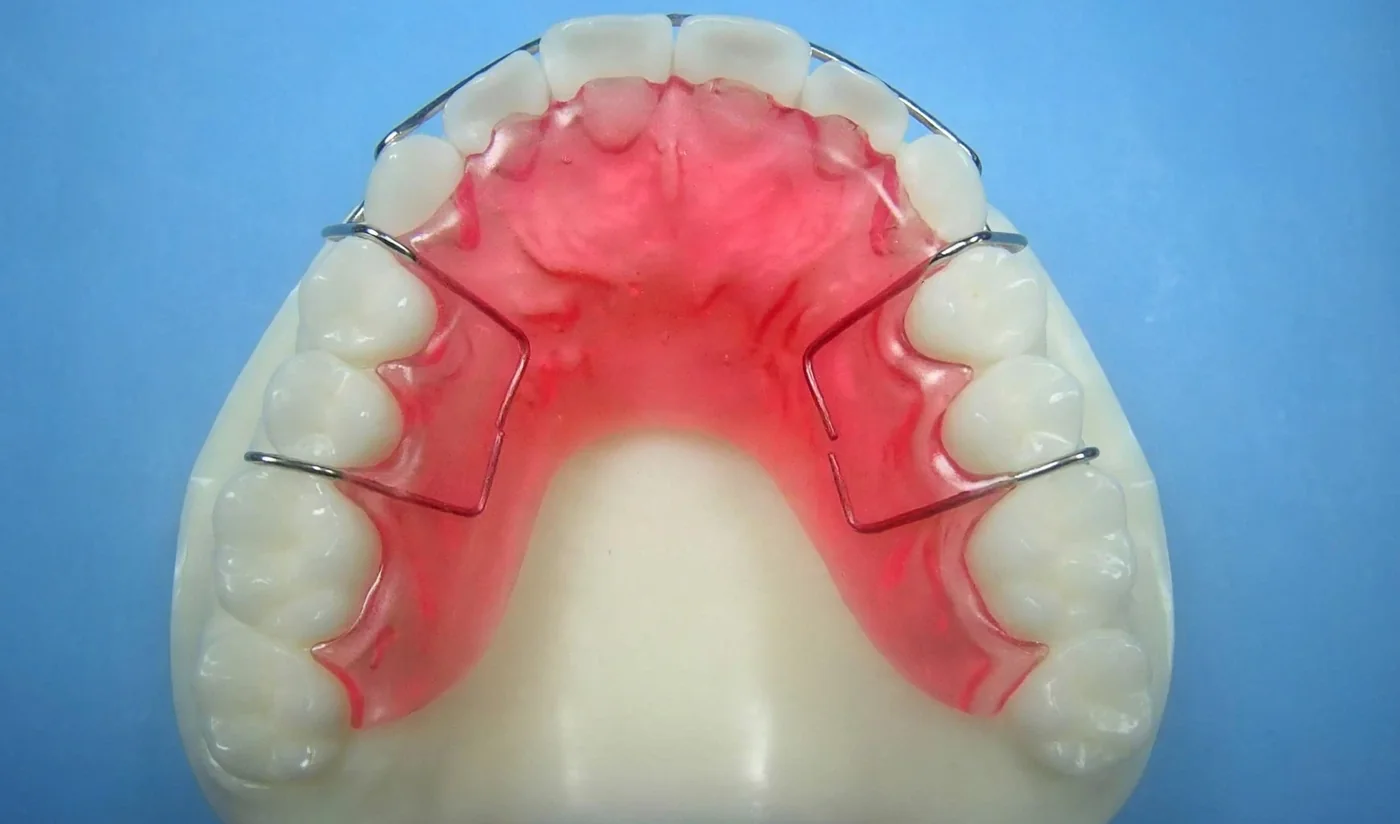
Hawley retainer on a model of the upper teeth: a pink acrylic plate, a wire across the front teeth, and wire clasps on the first molars

Studies so far suggest the two hold teeth about equally well, though the evidence is limited (Martin et al., Cochrane Database of Systematic Reviews, 2023). Clear retainers may wear out sooner. Either way, the choice is yours.

Putting it in and taking it out

Clear Essix retainers last longest when they go in and come out the same gentle way every time.

Clear Essix retainer: putting it in

  1. Brush and floss first, especially at bedtime, so food isn't trapped against your teeth all night.
  2. Rinse the retainer with cool water.
  3. Line it up over your teeth and press it into place with your fingertips, front teeth first, then both sides, until it sits down evenly.
  4. Don't bite it into place. Biting can crack the plastic or seat it crooked.

Clear Essix retainer: taking it out

  1. With clean hands, put a fingertip inside your cheek on the edge of the retainer behind your last back tooth.
  2. Gently ease that side loose, then do the same on the other side.
  3. Lift it off the front teeth once both sides are free.
  4. Don't pull it off from the front teeth only. That bends the plastic and cracks it over time.

Hawley retainer (acrylic and wire)

If your retainer has an acrylic plate and a front metal wire, always handle it by the acrylic and back clasps.

Putting it in

Line it up over your teeth and press it into place with your fingers on the acrylic plate. Never bite the wire into place.

Taking it out

Ease the wire clasps off your back teeth on both sides with a fingertip. Never lift by the front wire, because a bent wire changes how it holds your teeth.

Clean and store

A clean retainer stays clear, fresh, and comfortable to wear.

Clean it every day

  • Each time it comes out, rinse it with cool water so saliva doesn't dry on it.
  • Once a day, brush it gently with a separate soft toothbrush and clear mild liquid soap, then rinse.
  • Skip abrasive or whitening toothpaste.
  • A retainer cleaning tablet can help with cloudy buildup. Follow the package directions.

Store it safely

Whenever it's out of your mouth, it goes in its case. Most lost retainers were wrapped in a napkin at a restaurant or left on a nightstand where a pet found it. Keep the case in the same spot at home and bring it to every checkup.

Do

  • Brush and floss before it goes in
  • Rinse it every time it comes out
  • Keep it in its case when it's out
  • Bring it to every checkup so the fit can be checked

Avoid

  • Eating or drinking anything but plain water with it in
  • Hot water, boiling, the dishwasher, or a hot car
  • Abrasive or whitening toothpaste, bleach, or alcohol mouthwash soaks
  • Napkins, pockets, and anywhere a pet can reach

Troubleshooting

Don't force, trim, or glue a retainer at home. Most problems are quick to fix when we see them early.

Feels tight
Your teeth moved a little since you last wore it. Wear it more often, full time for a day or two if needed, until it goes in easily again. Call if it still feels tight after a few days.
Won't go in all the way
Don't force it or bite it down. Call or text the office soon. The sooner we see you, the more likely a small shift can still be corrected.
Cracked or broken
If it still fits and has no sharp edge, keep wearing it and call. If it's in pieces or sharp, stop wearing it, keep the pieces, and call right away. Wear your spare set if you have one.
Lost
Call right away and wear your spare set if you have one. We keep the scan of your finished teeth, so a new retainer can be made from it as long as your teeth haven't moved.
Rough edge or sore spot
Don't trim or file it yourself. Call, and your doctor can smooth the edge in the office.
Cloudy, stained, or smells
Usually dried saliva and buildup. Brush it daily with mild soap and use a retainer cleaning tablet. If it stays cloudy or the plastic is cracking, it may be time for a replacement.
Speech sounds different
A slight lisp for the first day or two is normal and fades as your tongue gets used to it. Reading out loud helps.

Call now or wait

Call or text (562) 904-6930. Visits are by appointment on set office days each month.

Call the office

  • Your retainer is lost, cracked, or broken
  • It won't go in all the way
  • It still feels tight after a few days of extra wear
  • A sharp edge or sore spot doesn't go away
  • A tooth has shifted or a space has opened

Usually can wait

  • Mild pressure when it goes in after a night off
  • A slight lisp for the first day or two
  • Cloudiness that cleans off
  • Questions about your schedule, which you can bring to your next checkup

Questions, answered

Still unsure about something? Call or text, or ask at your next visit.

My teeth look straight. Why keep wearing it?

Straight isn't the same as stable. For the first months, the bone around the roots is still remodeling and the gum fibers still pull toward the old positions. After that, teeth keep shifting slowly for life. That's why many adults who had braces as teens see crowding come back. Wearing a retainer at night keeps your result.

How long do I have to wear my retainer?

Our usual plan is daily wear for about the first 6 months, while the bone and ligaments settle around your teeth in their new positions. Then nightly, and after a couple of months of that, nightly or every other night at your discretion. Retainers are a lifetime habit if you want the result to last.

What if I forget for a few nights?

Put it back in tonight. If it feels tight, wear it more until it's comfortable again. If it won't go in, call or text the office instead of forcing it.

Can I drink with my retainer in?

Plain water, yes. For anything else, take it out first. Sugary or acidic drinks get trapped under the plastic and sit against your teeth, which can cause cavities and stains.

Should I get a second set?

We recommend it. Alternating two sets makes each one last longer, and the spare is your backup if one cracks or goes missing. Your written plan lists the retainers that come with your treatment.

Do retainers wear out?

Yes. Clear retainers are plastic, and plastic slowly deforms and can crack, so plan on a replacement about once a year. Because we keep the 3D scan of your finished result, a replacement can be made from that same scan, so it fits the way the first one did.

Dental term: bone remodeling. Bone is always being broken down and rebuilt by its own cells. Orthodontic treatment guides that process to move teeth, and a retainer holds them while it finishes.

Call(562) 904-6930Text(562) 904-6930